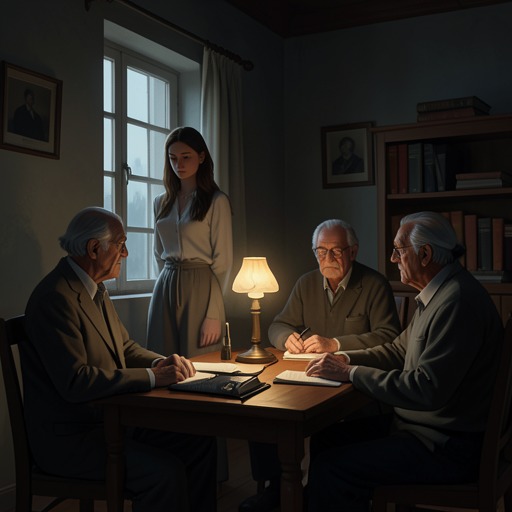
Giovanna meets Vittoria for the first time
The Lying Life of AdultsGiovanna meets Vittoria for the first time in an encounter that turns a family visit into a crossing between two versions of Naples and two competing accounts of her father’s past. The journey introduces her to the poverty and estrangement behind the relatives she barely knows; Vittoria’s forceful presence then makes the visit impossible to leave behind. The first meeting begins not with reconciliation but with fear, fascination, and a demand to see what her parents have kept at a distance.
The descent into a family world
For Giovanna, her mother’s family had belonged to a known place, Museo, and to affectionate memories of grandparents and an uncle. Her father’s relatives, by contrast, appeared only at weddings and funerals, in encounters marked by forced greetings and a false show of warmth. Afterward, her parents grew tense and seemed mutually willing to forget them. The family divide was also geographic: Giovanna’s world lay in the upper city, among familiar streets and Villa Floridiana, while the areas where her father’s relations lived seemed nameless, difficult to reach, and almost like another city.
The visit makes that imagined distance concrete. After several days of rain, her father drives through rows of bleak apartment buildings, warehouses, garbage-strewn green spaces, and puddles left by the weather. He dislikes the ring road and takes the old streets; as they enter the neighborhood, he grows somber, then tells Giovanna that he was born and raised there and that his family was poor. He points out a brick building with much of its plaster missing as the place where he lived and where Vittoria still lives. His words give Giovanna a glimpse of an origin he had not previously described, but his silence and visible strain leave the disclosure charged with unease.
At the building, Giovanna climbs uneven, broken stairs past damaged walls and graffiti. On the third floor, she finds three doors; only one bears a surname, Trada, written by hand on a strip of paper. She rings once and counts to forty, following advice her father had given her for moments of uncertainty, before ringing again. The small, exact act of counting becomes part of the scene’s tension: she is inside her father’s old home, at the threshold of a relative whose existence has been surrounded by family anxiety.
The first encounter
Vittoria opens the door after a shout in dialect and several turns of the key. Tall and very thin, with broad shoulders, a large chest, and a mass of black hair, she appears in blue, smoking and coughing. Her abrupt manner unsettles Giovanna from the start. When Giovanna identifies herself and calls Vittoria “aunt,” Vittoria rejects the title so sharply that Giovanna is frightened into silence.
The child studies Vittoria’s unmade-up face and then looks down. She perceives a beauty so overwhelming that she feels compelled to regard Vittoria as ugly instead. The contradiction reveals how quickly the encounter defeats the categories Giovanna has brought with her: her aunt is neither the distant, frightening figure conjured by her parents nor someone Giovanna can calmly admire. The face itself becomes an immediate challenge to her inherited expectations.
Vittoria leads her into a home that smells of smoke, with a kitchen whose orderliness strikes Giovanna amid the surrounding odors of cigarette butts and filth. The visit moves between discomfort and an unfiltered intimacy. Vittoria speaks about Giovanna’s father with anger, recounting how he dismissed her wish to become a dancer and valued books and study above other people’s ambitions. She also says that he first let Enzo believe they were friends and then destroyed him emotionally. Her accusations are not neutral family history: Vittoria’s face shifts through remorse, aversion, rage, and melancholy, and she breaks off when emotion overtakes her at Enzo’s name.
A memory that continues after the visit
Giovanna does not defend her father while Vittoria is speaking. Left alone for a moment, she spits orange seeds from her mouth into a glass and feels ashamed that she has not objected to the insults. Then music rises sharply in the small room. Vittoria stands by the window, where she can see Giovanna’s father waiting in the car, and moves to the rhythm. She explains that the music should make him remember: she and Enzo danced to it the first time they met.
Vittoria brings Giovanna into the dance, placing the girl on her feet and whirling her around the room with precision and elegance. When the music ends, she holds Giovanna close and instructs her to tell her father that they danced the very dance she had first danced with Enzo. The gesture is tender in its physical closeness but also pointed: Vittoria sends the child back to the waiting father carrying a memory he would rather not share. The dance gives Giovanna a bodily experience of Vittoria’s attachment to Enzo and of the family history that her parents’ silence had obscured.
The first visit persists in Giovanna’s mind after she has left. She later recognizes that, even as she said she was afraid to see Vittoria again, she already knew when and where the next meeting would happen. Her aunt’s words, gestures, and expressions seem not merely remembered but still underway. She recalls Vittoria in sky blue, ordering her to close the door and turning away as though Giovanna could only follow; the woman’s impatience strikes her with the sudden force of a flame. The recollection makes the encounter a continuing presence rather than a completed introduction.
Kinship, looking, and belonging
Vittoria later takes Giovanna to meet other paternal relatives, calling the journey a visit to her blood. They travel by green Fiat 500 to see Uncle Nicola in Campi Flegrei, Aunt Anna in Cavone, and Aunt Rosetta in Pozzuoli. Giovanna realizes she can barely remember them and may never have properly learned their names. Vittoria notices and blames Giovanna’s father for depriving his daughter of the affection of relatives who, despite their lack of education and polish, are warm-hearted.
The visits complicate the hostility Giovanna has associated with her father’s family. The apartments are small and drab, and their furnishings belong to a world she has been taught to consider crude or vulgar; Aunt Anna’s home is the only one where Giovanna sees books, in this case mystery novels. Yet the relatives welcome her with an ease that surprises her. They speak in dialect mixed with Italian, and Giovanna tries to answer in kind, making room for Neapolitan cadences in her hypercorrect Italian. They do not ask her to greet her father or accuse her on his behalf; instead, they make clear that their anger is not directed at her.
They call her Giannina, as Vittoria does, rather than Giovanna, the name used by her parents, Angela, Ida, and her classmates. In their company, she feels unusually open, relaxed, and funny, and wonders whether Vittoria’s name for her has brought forth another self. Uncle Nicola remembers that Vittoria likes strawberry gelato and sends one of his children to buy some for everyone when he learns Giovanna likes it too. His affectionate attention gives the newly encountered family a warmth that contrasts with the strained, obligatory visits of Giovanna’s childhood.
Vittoria turns these excursions into lessons in attention. She tells Giovanna that she has blinders like a horse: she looks, but fails to see what might disturb her. Her repeated command to look insists that kinship is not only a matter of blood or a name but also of being willing to register what one’s parents have left outside the frame. The first meeting begins this education in seeing, while the relatives’ welcome demonstrates that the lower city Giovanna had imagined as alien contains forms of belonging unavailable in her familiar world.
Consequences and significance
The encounter does not resolve the estrangement between Vittoria and Giovanna’s father, nor does it settle which account of the family is true. Instead, it places Giovanna between them. She arrives under the influence of her parents’ fear and aversion, but leaves with Vittoria’s voice, face, music, and movement lodged in her memory, along with a message intended for her father. The later visits deepen that divided position: affection from the relatives draws her toward them, while their treatment of Vittoria reveals a tenderness shaped by the knowledge that she is loved and unfortunate.
As an introduction, the visit is decisive because it joins spatial descent to a change in perception. The route from the heights of Naples to the building where her father grew up exposes the material and emotional distance separating Giovanna from his family. Inside, Vittoria’s beauty, anger, grief for Enzo, and insistence on looking unsettle the orderly judgments Giovanna has inherited. The first meeting does not make the girl choose between her parents and her aunt; it makes the family’s hidden divisions—and the possibility of another self within them—impossible to ignore.